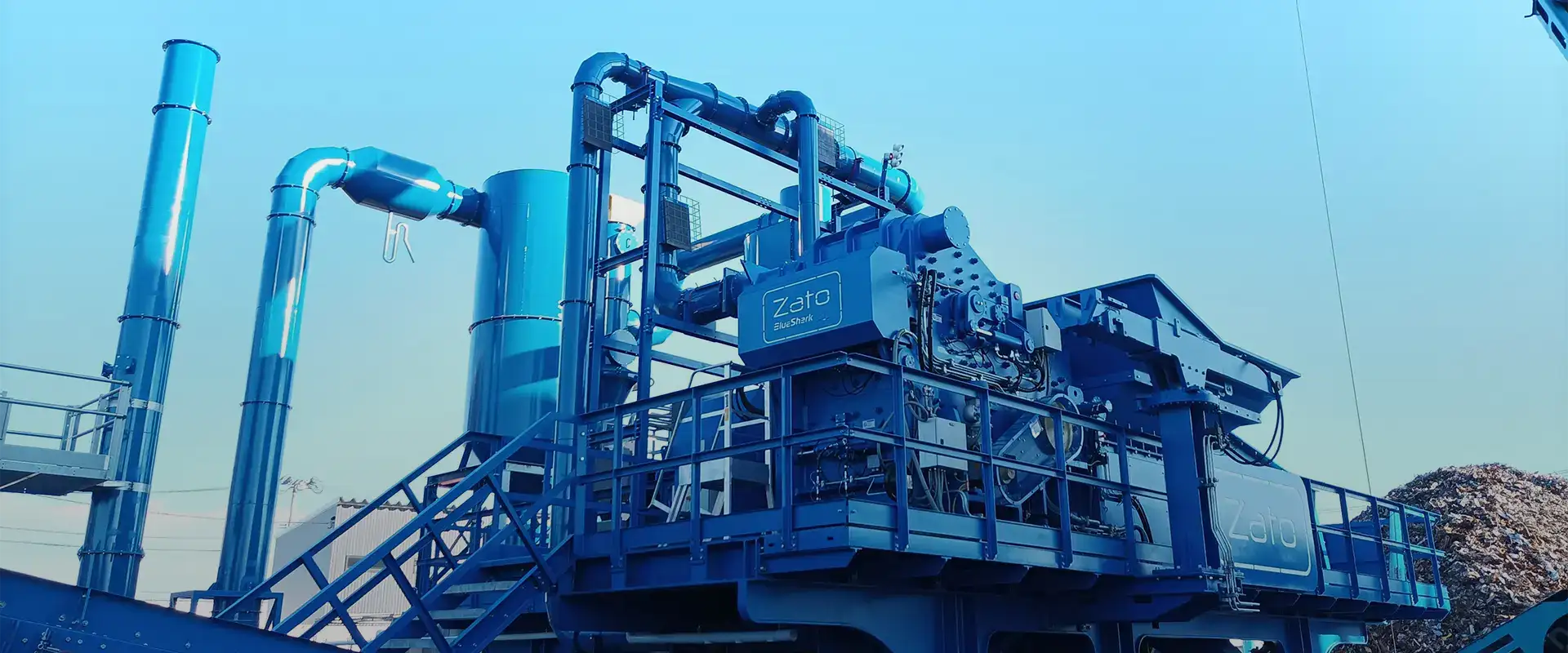
Industrial Metal Hammer Mill: the Blue Shark Range
Zato designs and builds a complete range of hammer mills for shredding ferrous and non-ferrous metals, delivering high results in terms of size reduction, cleanliness, and purity of the final product. Every industrial metal hammer mill in the Blue Shark family is engineered to produce a superior-quality output while keeping operating costs among the lowest in its class. From the powerful Blue Devil pre-shredder to the highly effective Blue Sorter separation lines downstream, Zato offers a solution for every shredding need and can integrate efficient processing systems directly into your existing facility.
General features
- High performance: optimally designed rotors allow efficient and rapid shredding of ferrous materials.
- Versatility: The Zato hammers process a diverse array of ferrous scrap, including mixed and non-ferrous materials, for flexible recycling applications.
- Ruggedness and durability: Built with resistant and reinforced materials, mobile hammer mills are designed to withstand harsh conditions and ensure long-lasting durability over time
- Ease of operation and maintenance: user-friendly, accessible control systems make operation and maintenance straightforward, reducing downtime.
- Compactness: the space-saving design lets these hammer mills be used and relocated both indoors and outdoors, a key feature of the Blue Shark FP 12.10.
A complete metal recycling hammer mill platform
Positioned as a metal recycling hammer mill, the Blue Shark turns mixed loads into homogeneous, high-density material ready for the furnace. Whether you run a compact yard or a high-throughput plant, an industrial scrap hammer mill from Zato keeps a steady feed and a clean cut, so each scrap hammer mill delivers consistent particle size. Across the line, Zato scrap metal hammer mills are available from 315 kW to 2200 kW with a production capacity ranging from 4 tons per hour to over 60.
Why choose Blue Shark hammer mills
- Innovative design: Built with welded steel plate structures and reinforced plates, ensuring robustness and durability. These features minimize ancillary costs and simplify installation, eliminating the need for costly civil works.
- Available power: from 315 kW to 2200 kW.
- Production capacity: from 4 tons per hour to over 60.
- Pre-assembly and testing: units are pre-assembled and tested in-house before shipping, reducing assembly time to as little as three weeks.
- Easy maintenance: on the 16.13 and 19.22 models, on-board extraction equipment and a maintenance platform make hammer replacement simple.
- Latest technology: PLC control for real-time machine management, with an HMI and integrated diagnostics for wear monitoring.
The Blue Shark range: three models
The industrial metal hammer mill line is built around three Blue Shark models. They share the same engineering principles but differ in size, power and motorization, so each fits a different throughput and footprint requirement.
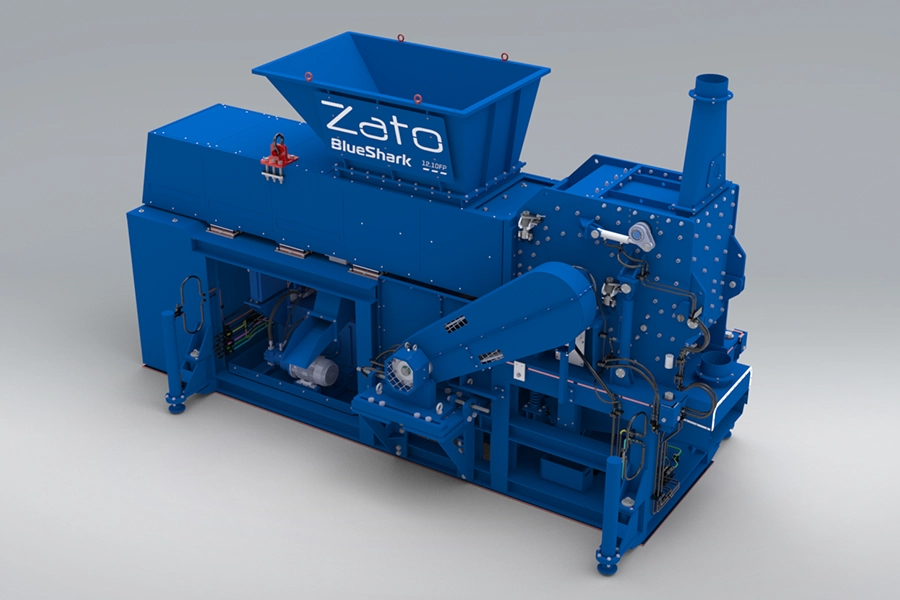
Blue Shark 12.10
The most compact model in the range. It is electric-driven from 315 to 450 kW, with a belt-driven transmission and fixed filling joint. With a total weight of 37.5 t, a height of 4.7 m and a 7.4 × 3.2 m footprint, its space-saving design lets it be installed and relocated both indoors and outdoors — the ideal scrap hammer mill for compact yards or sites where space is limited. The rotor measures 1.2 m in diameter with open hammers and 1 m in width.
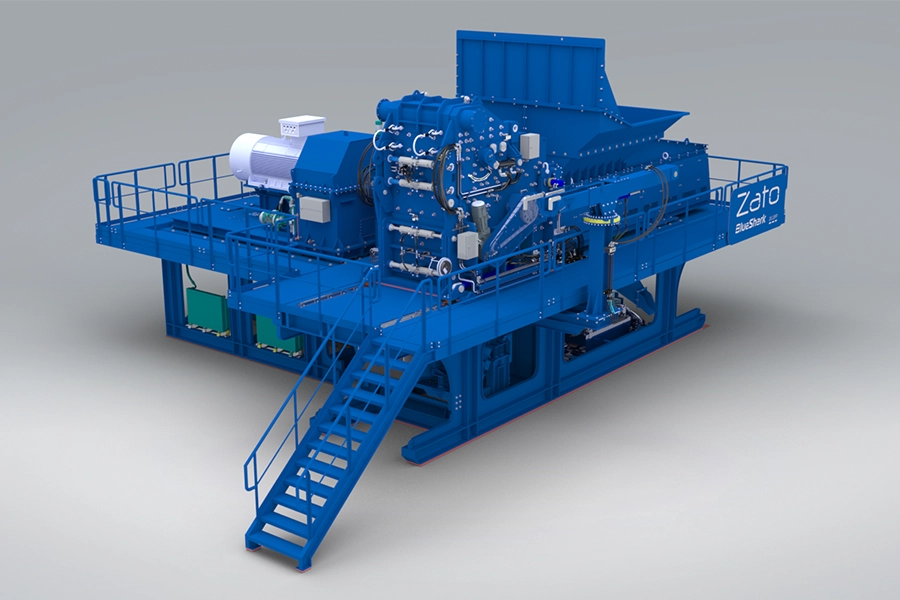
Blue Shark 16.13
The mid-range model, available with electric or diesel motorization at 900 kW / 1220 HP and a universal-joint transmission with variable-filler viscous coupling. It weighs 131 t and runs a 1.6 m rotor (open hammers) that is 1.3 m wide. On-board extraction equipment and a maintenance platform allow fast hammer replacement, making this metal recycling hammer mill well suited to operations that need higher throughput with flexible power options.
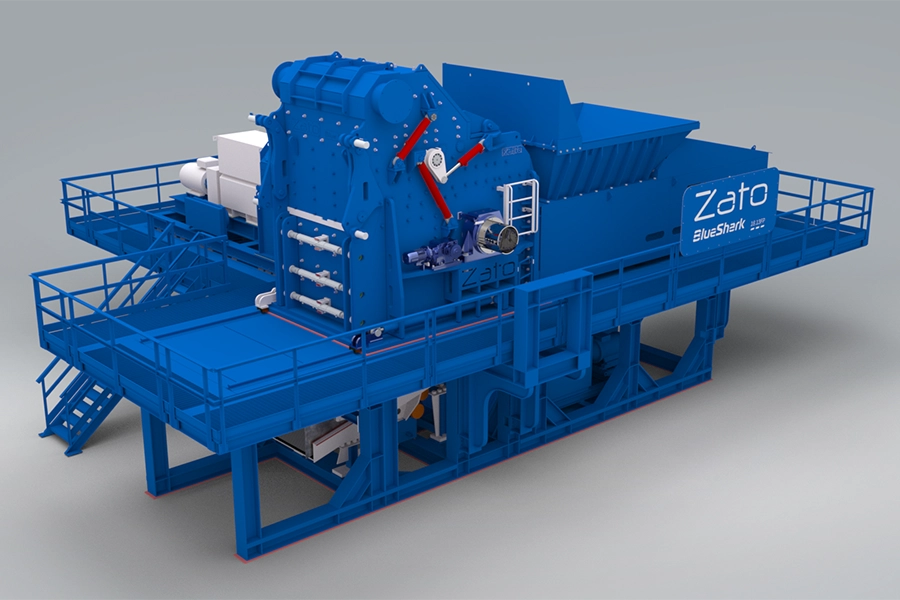
Blue Shark 19.22
The largest, highest-capacity model: electric-driven from 1500 to 2200 kW, with a universal-joint transmission and variable filler viscous coupling. With a total weight of 210 t and a 1.9 m rotor (open hammers) that is 2.2 m wide, it delivers maximum production for high-throughput plants. Like the 16.13, it carries on-board extraction equipment and a maintenance platform, so this industrial scrap hammer mill keeps hammer changes and servicing fast even at the top of the range.
Blue Shark hammer mills – technical data
| Blue Shark 12.10 | Blue Shark 16.13 | Blue Shark 19.22 | |
| Total weight | 37,5 t | 131 t | 210 t |
| Engine power | 315 kW – 450 kW | 900 kW / 1220 HP | 1500 kW – 2200 kW |
| Motorization | electric | electric/diesel | electric |
| Height | 4.7 m | 5.8 m | 7.5 m |
| Width | 7.4 m | 11.3 m | 17 m |
| Depth | 3.2 m | 15 m | 13.6 m |
| Rotor diameter (open hammers) | 1.2 m | 1.6 m | 1.9 m |
| Rotor width | 1 m | 1.3 m | 2.2 m |
| Transmission | belt-driven, fixed filling joint | universal joint, variable filler viscous coupling | universal joint, variable filler viscous coupling |
Video Hammer Mills
Blue Shark
Aluminium recycling leader in Belgium upgrades with Zato shredders
Zato | Pre-shredder and hammer mill: from aluminium scrap to foundry-ready metal
Zato | An integrated metal recycling system in Panama
Zato | Pre-shredder, hammer mill and separation lines combo for metal recovery
Zato | Hammer mill: a Blue Shark 16-13 for revolutionary aluminum recycling
Zato | Integrated recycling system for higher-quality scrap
Perfect combo: Blue Devil twin-shaft shredder, Blue Shark hammer mill, Blue Sorter separation line
Twin shaft shredder + hammer mill + separation line: the perfect combination
Sapa with Zato for a greener future
The ideal scrap yard: Access Metal Recycling chooses Zato industrial shredders
Blue Shark FP 16-13 on-site assembly in record time
Blue Shark FP 16-13 on site assembly in record time
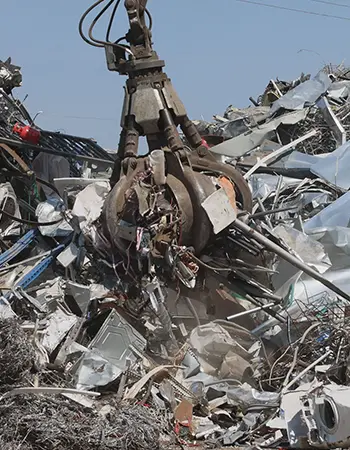
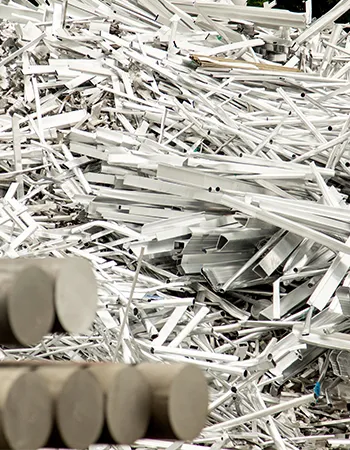
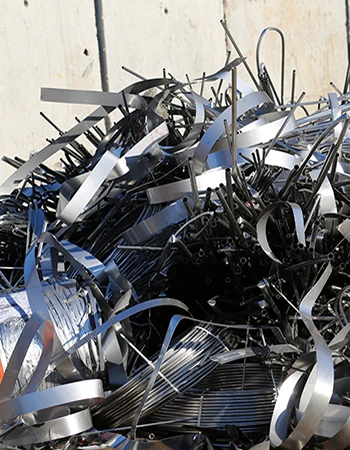
Our metal hammer mills are ideal for processing:

FAQ
What type of hammer mill is recommended for processing aluminium scrap in combination with LIBS?
To achieve optimal LIBS separation, it is essential to ensure effective contaminant liberation from the aluminium. The single-shaft shredder (Blue Marlin) is ideal due to its precise control of output size and minimal fine generation, keeping the material open and suitable for LIBS sorting. For higher volumes (over 10–15 t/h), a hammer mill is recommended for its processing capacity. In both cases, a pre-shredding step with a twin-shaft shredder (Blue Devil) is advised to open bales, remove unshreddables and improve downstream efficiency.
What is the most compact hammer mill on the market?
Unlike conventional mills that require long conveyors for gravity feeding, the Zato hammer mill stands out for its compact design. Its hopper and hydraulic pusher system eliminates the need for inclined belts, reducing space requirements and maintenance costs. This allows installation in tight spaces while maintaining high performance.
What kind of feeding system works best?
An effective feeding system is key to ensuring continuous and safe hammer mill operation. Traditional systems rely on steel conveyors, dosing rollers and gravity chutes, which require constant operator input and have high operating costs. The Zato system replaces all of that with an automated hydraulic pusher controlled by electronics, which optimises material feed in real time—improving efficiency and reducing reliance on operators.
How often should hammer mill hammers be replaced?
Hammer replacement frequency depends on multiple factors: the type of material processed, the hammer’s properties and operational conditions. Feeding compact scrap leads to faster wear, while pre-shredded material significantly extends hammer life and lowers operational costs. Proper feed preparation is key to minimising wear-related expenses.
Is it easy to change the screen or adjust the output size of the hammer mill?
In conventional mills, replacing the screens is time-consuming and complex. Zato has developed a rear-extraction system with hydraulic control that allows screen changes in just a few hours, without lifting the rotor. This increases operational flexibility, simplifies maintenance and improves overall plant efficiency.
How many days are needed for installation?
Conventional hammer mills require over 5–6 months to install due to complex civil works and foundation needs. Zato’s mill, built on a self-supporting steel structure, can be fully installed in under 30 days, significantly reducing time, cost and setup complexity.
Are there customizable or tailor-made models available?
No, our production is based on standardized models. This approach allows us to ensure short delivery times, spare parts always available, and quick, efficient maintenance. Standardization means offering reliability, operational continuity and faster technical support — without compromising performance.
What is the delivery time for a Zato hammer mill?
Thanks to standardized models and continuous production, Zato hammer mills are generally available with a delivery time of about 3 months from order confirmation.
How many people are needed to operate a hammer mill?
Conventional systems require at least two operators: one for the loading crane and one for mill feeding, plus personnel for manual sorting. With Zato technology, the same crane that loads the shredder also feeds the mill, so only sorting staff are needed.
Which machine is required to produce proler / E40 / Shred 210?
The ideal machine is the hammer mill. Its ability to crush and liberate metals ensures a homogeneous, high-density output that meets industry and furnace standards.
Do you need more information?
Fill out the form, and we will respond to you as soon as possible!
You are reaching out to Zato Europe. If you would like to contact Zato North America, click here